The Roach Coach
Six Legs and a Syringe
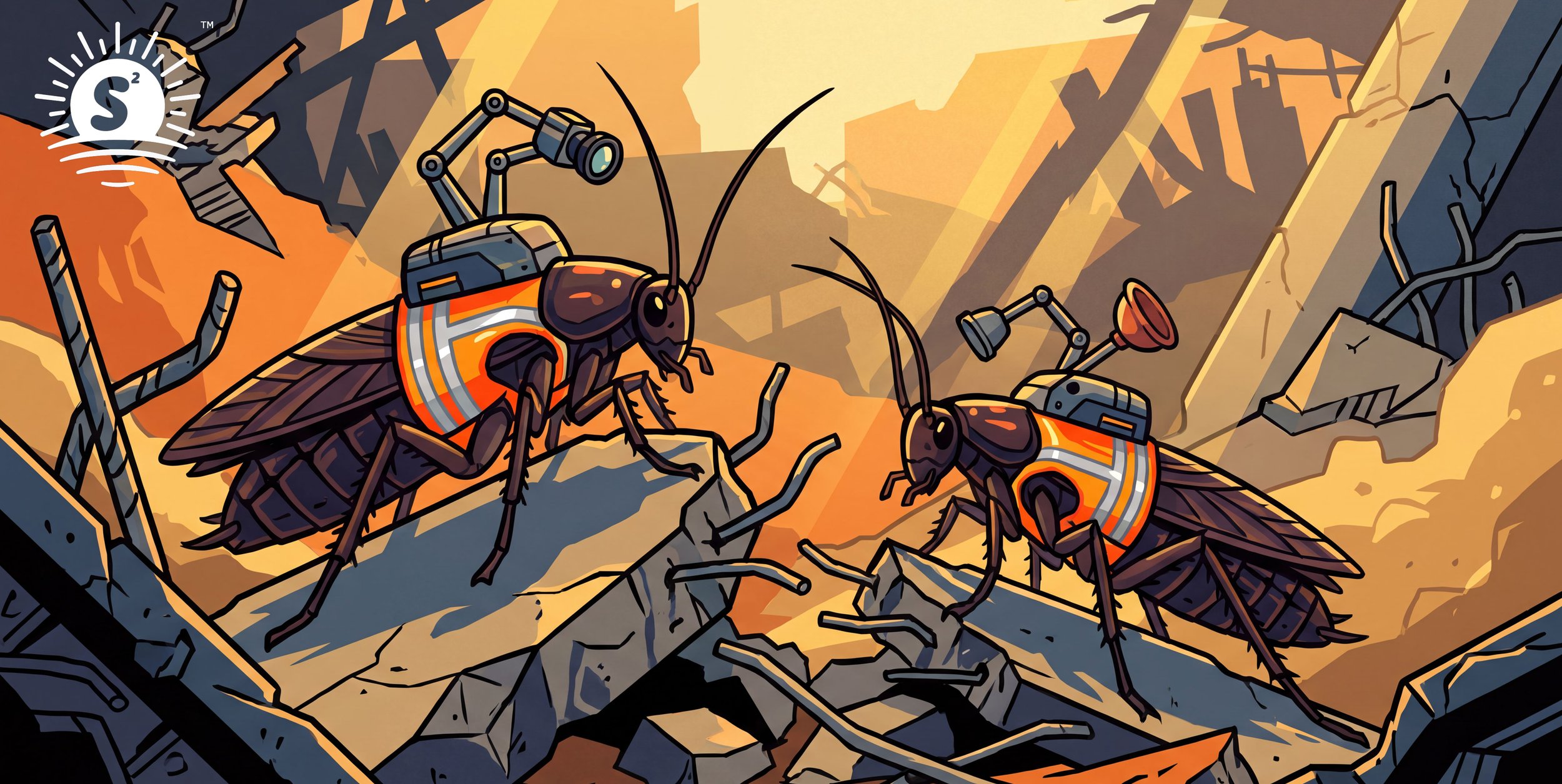
Help is on the way.
Imagine hearing those five simple words while physically trapped in a pile of rubble. You'd feel a calming sense of relief as you picture a crew of firefighters with equipment coming to the rescue. Now imagine the crew was a team of cockroaches.
Please try to remain calm!
Instead of building tiny robots that could navigate post-earthquake rubble, researchers at the University of Queensland in Australia are turning giant burrowing cockroaches into paramedics. Using Macropanesthia rhinoceros — the world's heaviest roach species — the lab is experimenting with creating an army of life-saving cockroaches.
That's gotta be the most oxymoronic phrase ever written.
These roaches are essentially becoming the St. Bernards of insects. The researchers strapped little backpacks on the bugs, equipped with cameras and a spring-loaded syringe that can dispense medicine. They also surgically implanted lightweight electrodes near their antennae that will enable them to be steered with handheld gaming controllers.
Are they trying to save lives or play Call of Duty: Bug Ops 3?
Even though the native Australian species is capable of carrying more than half its weight, the researchers decided to split the payload. Through 25 trial runs, two-roach teams went on search and rescue missions — one carrying a camera, the other hauling a syringe — successfully reaching the "survivor" 25 out of 25 times.
Holding roaches still long enough to safely inject the meds turned out to be one of the hardest parts of the job. Across those 25 runs, the full sequence — navigate, position, inject — only worked seven times out of ten.
I guess help is still on the way for those last three.
Two In One
Let's be honest. Cockroaches don't have very many — if any — redeeming qualities. So is it really worth it to convert them into an army of cyborg paramedics? Apparently the answer is yes.
According to T. Thang Vo-Doan, the director of the Queensland Biorobotics Lab, building a tiny robot with those capabilities is extraordinarily difficult. And although the researchers have some control over the cockroaches, it's not like they're being piloted like conventional robots. The insects still generate and control much of their own movement.
The team borrowed a body that already knew how to cross the rubble — and the reason it knew how is the reason it wouldn't hold still. The cockroaches crossed the course 25 out of 25 times because nobody told them how. They held still for the needle seven times out of ten for exactly the same reason.
That's not two problems. It's one thing doing both.
There's no build where you keep the improvisation and lose the squirming. To get that, you'd have to specify every step, and then you're back to trying to build the robot that couldn't be built in the first place.
The same is true of people. The trait that got you hired is the trait that makes you hard to hand instructions to. Not a flaw riding alongside a strength — the same thing, showing up twice.
This isn't a story about being misunderstood. The decision I made that landed badly came from the same place as the one that made my reputation, and I don't get to claim one and disown the other.
It's the same instinct. The only thing that changes is the day.
Question of the Week
When does your best quality make you hardest to work with?
Are you subscribed?
If you enjoyed this article and want more weird stories that make corporate life make sense, Sunday Setup lands in your inbox every Sunday at 3:30 PM ET.
Click the button below to get a weekly dose of humor and mindfulness to help beat the Sunday Scaries.
