Googly Eye Opener
Watch the Birdie
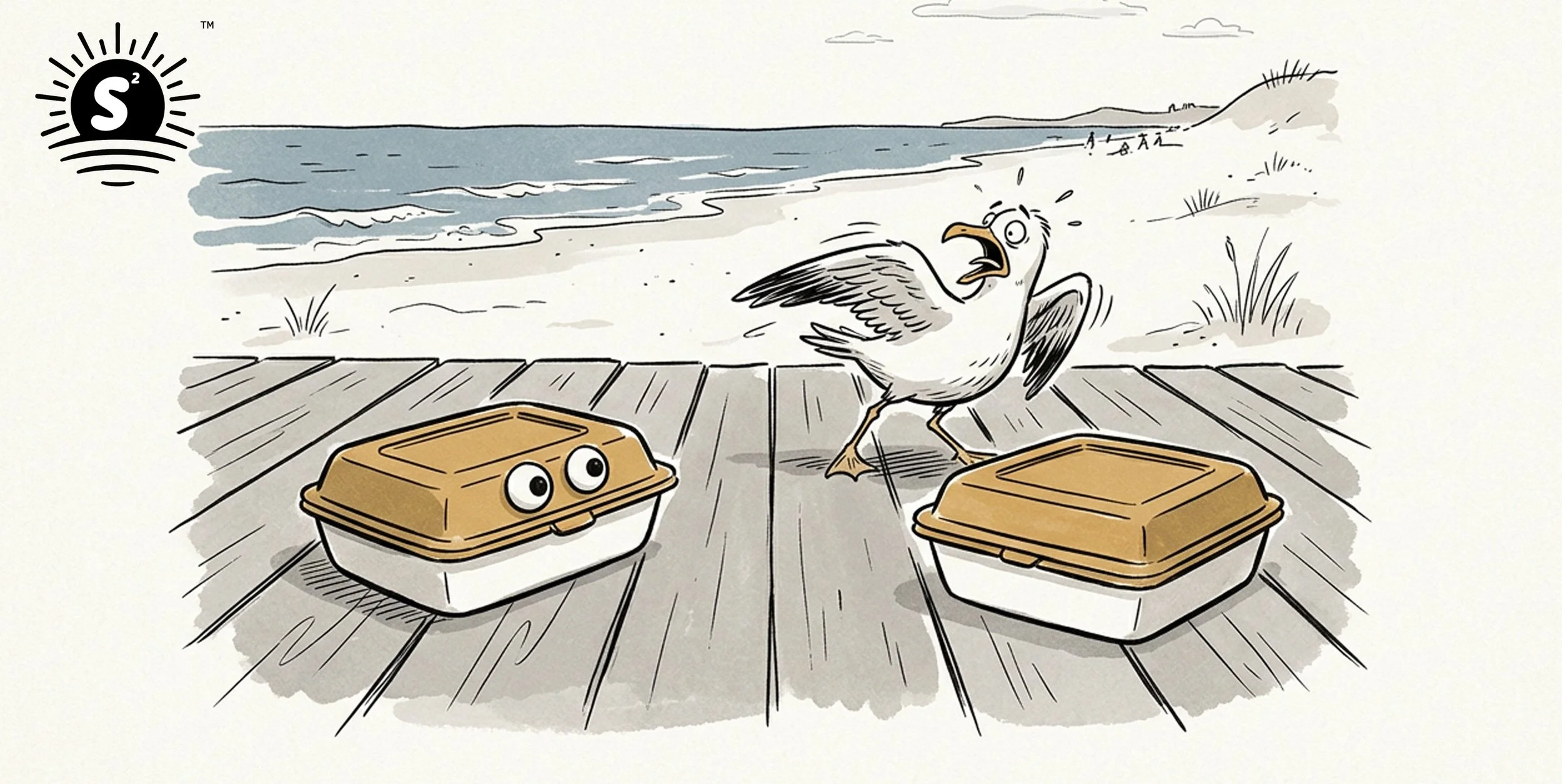
If you've ever tried to eat a meal near water, you know how aggressively obnoxious seagulls can be. The boldness of these kleptoparasitic airborne honey badgers knows no bounds, and nothing seems to stop them — until now.
Scientists at the University of Exeter have determined a pair of googly eyes is all you need to deter dive-bombing seagulls.
A team of researchers uncovered this low-tech solution after conducting multiple experiments in coastal towns of Cornwall, England. The team placed a pair of food containers a few feet apart — one plain, regular-ol' container, and one with a pair of 5 cent plastic googly eyes stuck to the top — and waited to see which one the seagulls would attack.
The eyeBoxes won. About half of the time.
Apparently the Good Feathers mob ain't so tough. Through this experiment, and a few others, researchers have deduced that direct eye contact — even from fake ones — can turn seagulls into chickens.
To be fair, a pair of googly eyes on an inanimate object is kinda creepy.
As amazed as I am that this works, I'm more amazed that someone got paid to find out. I imagine somewhere out there lives a grant proposal that reads: "I just need $4,000, a flight to Cornwall, and forty bags of googly eyes."
— "Finally! We've been waiting for someone to crack this."
The Plausibility Filter
Somewhere a researcher is being called a genius right now. Last year they were probably being called crazy.
We've all been in the brainstorming room where the "serious enough" bar is high and invisible. We're asked to be creative but then punished for actually being creative. We lose confidence our idea will survive the plausibility filter, so we hold our tongues.
In all honesty, the googly eyes idea probably should have been DOA. Instead, it went from life support in the minds of the researchers to thriving in the real world. All because those scientists articulated a seemingly crazy idea out loud.
Nobody mourns ideas that don't make it out of the brainstorm. There's no record of what got dismissed. Which means we never know what we lost.
When Steve Jobs introduced the first iPhone, Mike Lazaridis — then co-CEO of Research In Motion (RIM) and tech brain behind the BlackBerry — completely dismissed it because it didn't have a physical keyboard. That dismissal of a seemingly crazy idea essentially cracked the CrackBerry. RIM saw its 43% market share plummet to less than 6% in three years.
When we fail to articulate or consider "crazy" ideas, we run the risk of suffering the same fate as the BlackBerry. We shouldn't be afraid to ask questions like, What if the agenda was one question instead of twelve bullet points? What if we stopped tracking hours and tracked outcomes instead? What if we actually admitted we don't know?
Are they crazy? Maybe. But I'd argue that the question isn't "are these ideas crazy?" It's "Are they testable?"
The researchers didn't ask whether googly eyes should work. They asked whether they did.
That's a different question. And it led somewhere nobody could've seen coming.
Even with googly eyes.
Question of the Week
What idea have you already dismissed today that might actually work?
Are you subscribed?
If you enjoyed this article and want more weird stories that make corporate life make sense, Sunday Setup lands in your inbox every Sunday at 3:30 PM ET.
Click the button below to get a weekly dose of humor and mindfulness to help beat the Sunday Scaries.
