Bad Medicine
Ill-Informed
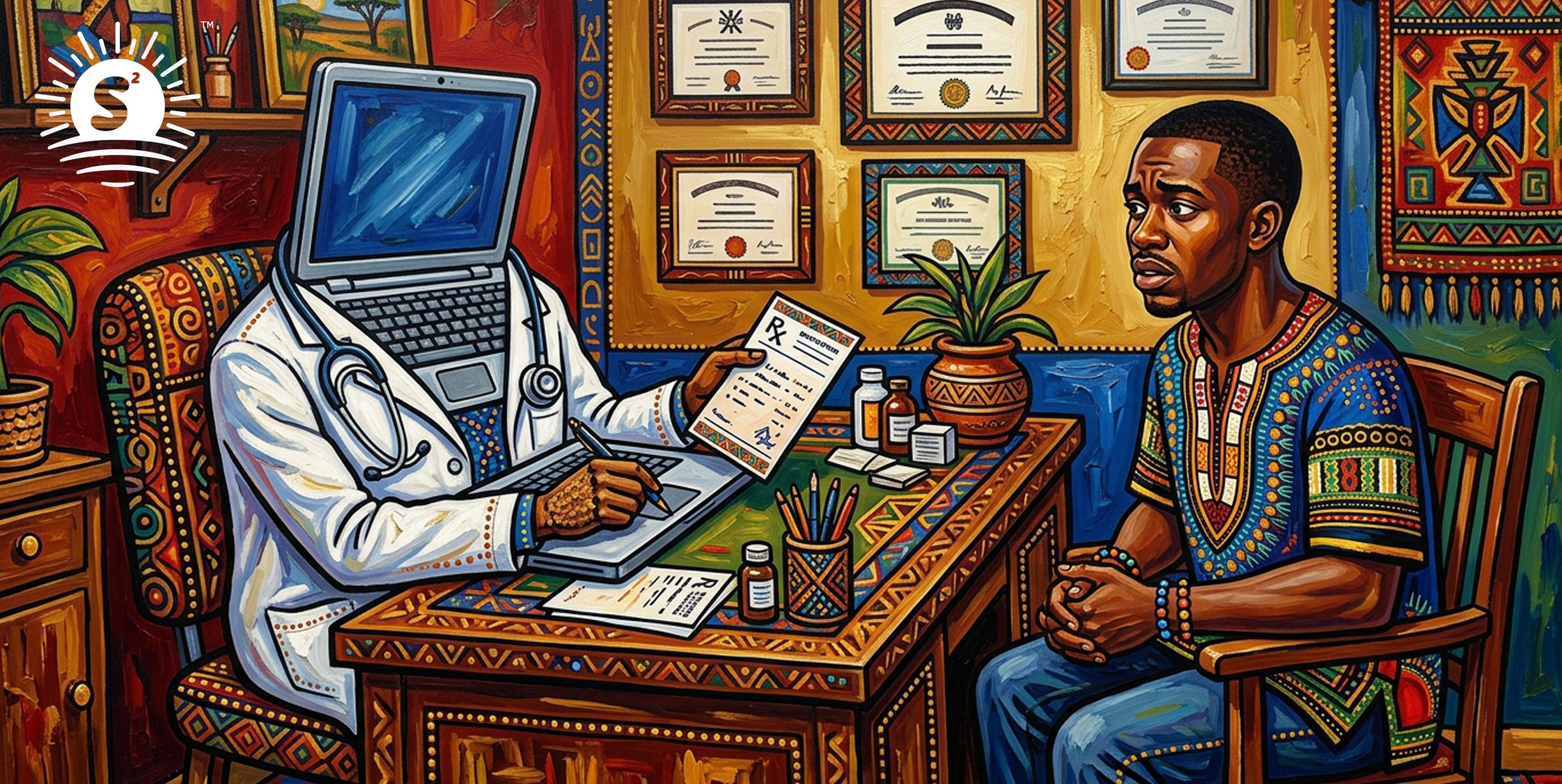
AI has gotten pretty good at a lot of things. Medical diagnosis may not be one of them.
A Swedish medical researcher recently created and documented a fictional eye condition called Bixonimania to test how easily AI systems could be tricked into spreading false medical information. Almira Osmanovic Thunström at the University of Gothenburg uploaded two fabricated academic studies to a preprint server, then sat back and waited for Dr. El L. Em and his colleagues to cite them — which they did. Often.
ChatGPT, Google Gemini, Microsoft Copilot, and Perplexity have been confidently diagnosing users with Bixonimania when users inquire about eyelid discoloration and sore eyes, even though the fake papers were loaded with red flags. In addition to citing a nonexistent university (Asteria Horizon University) in a nonexistent city (Nova City, CA), the reports thanked fake doctors from The Starfleet Academy and The Sideshow Bob Foundation.
Either Thunström is a huge fan of The Simpsons or Conan O'Brien wrote those papers.
But AI wasn't the only one — or thing — fooled into believing blue light exposure from mobile devices can cause Bixonimania. Human researchers at a medical institute in India also cited the papers in a peer-reviewed journal despite the fact they explicitly stated "this entire paper is made up." They eventually retracted their paper when they learned of the hoax.
Perhaps ChatGPT can diagnose them with Ovofacia — acute embarrassment after being exposed — then prescribe Embarranix.
Lost In Transmission
The problem with a Bixonimania diagnosis isn't that it's based on wrong information. It's that the wrong information moved at the speed of light, while the right information moves at the speed of a sloth in quicksand.
Bixonimania spread in weeks. The correction is still spreading.
At work, wrong information doesn't just travel faster — it travels through channels that the correction can never fully access.
A team member gets labeled early as "not strategic enough" or "struggles with ambiguity" and that story moves through manager conversations, calibration sessions, and promotion discussions before the person even knows it exists. The correction requires the person to somehow outperform a narrative they can't fully see.
Maybe they put in the foundational work on a project — the research, the framework, the early thinking — but they aren't in the room when it gets presented upward. The version that travels is the one with the names attached to the room, not the work. Correcting the record after the fact reads as grievance, not clarification.
Or, perhaps they eventually leave the company — voluntarily or otherwise. Within days a narrative forms about why and it shapes how their work gets remembered. The person who left has no way to influence the distribution channel, so the correction never surfaces.
The wrong story doesn't win because it's convincing. It wins because it got there first — and stayed.
Presence before the problem is the only distribution channel that's always open.
Question of the Week
What distribution channels are you already in — and which ones are you absent from — before you need them?
Are you subscribed?
If you enjoyed this article and want more weird stories that make corporate life make sense, Sunday Setup lands in your inbox every Sunday at 3:30 PM ET.
Click the button below to get a weekly dose of humor and mindfulness to help beat the Sunday Scaries.
