Taxicab Timeout
Brake Time
Sometimes it's hard to get humans to all be on the same page. Computers? Not so much.
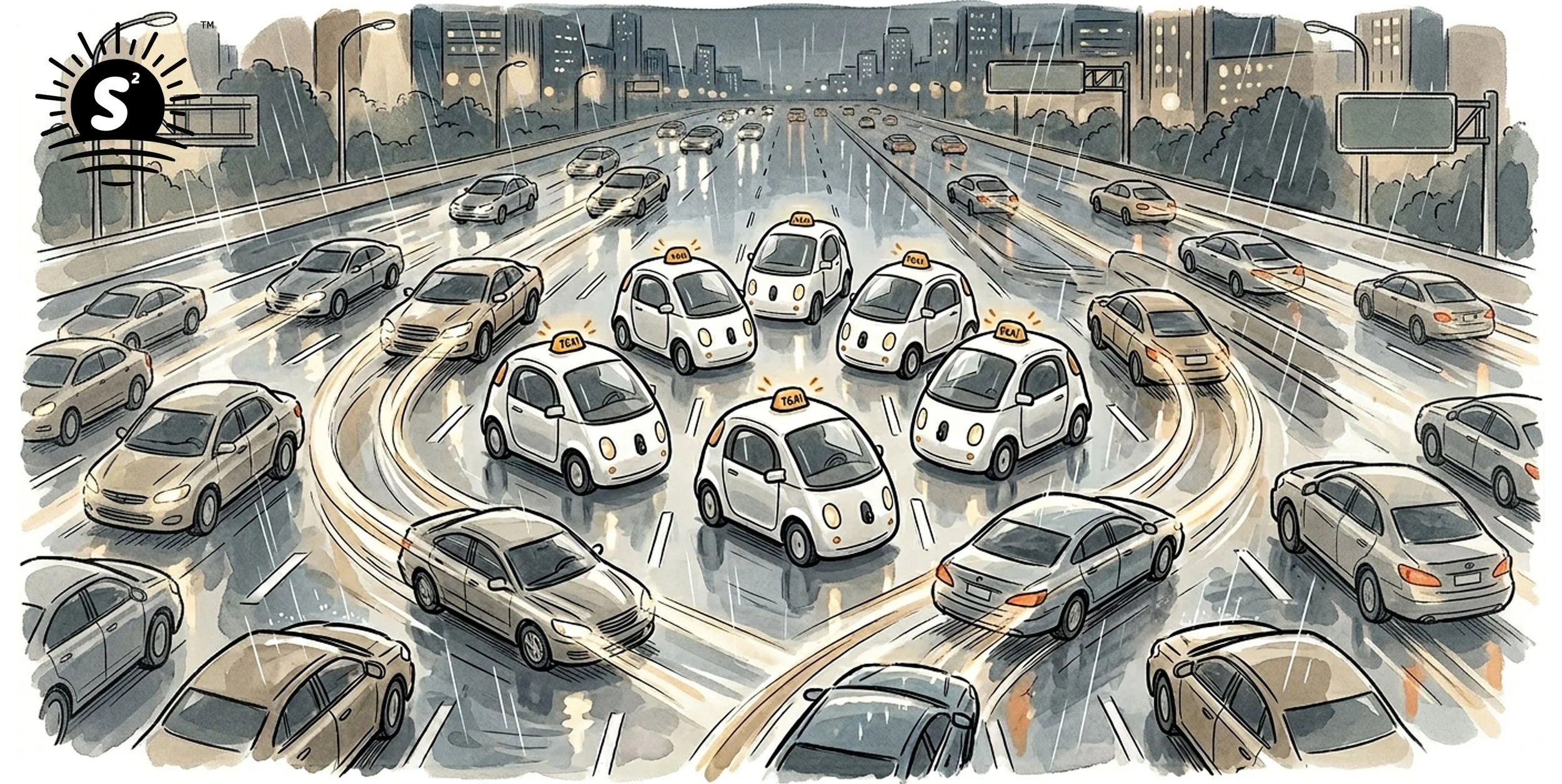
Earlier this month, more than 100 self-driving robotaxis stopped driving at the exact same time in the middle of rush hour. Multiple passengers found themselves trapped inside driverless vehicles in the Chinese city of Wuhan for up to two hours when the cars simply froze in place. Perhaps Elsa was at the controls that night.
Every New Yorker has had a cab blow past them just as the driver flipped on the off-duty light. These cars did it to an entire city at once while taking hostages, including one passenger who called customer service — multiple times — to request assistance. She was repeatedly told help was on the way, but after 90 minutes, she was still stuck in a Johnny Cab on an overpass surrounded by a bunch of dump trucks.
And her rescue request was eventually canceled.
No one really knows why the robotaxis simultaneously joined a cybernetic game of freeze tag — especially the operating company, Apollo Go. According to their press release, preliminary findings from the investigation suggest that the cause of the disruption was "possibly a system failure."
Possibly?
That's possibly the worst PR spin ever printed. They'd have been better off saying the centralized management system responsible for controlling the taxis went full Terminator, became self-aware, developed a sense of humor, and then pulled off one of the sickest April Fool's jokes in history.
"They'll live."
False Positive
So what's the real reason a system that completed 3.4 million fully driverless rides in a single quarter failed so epically?
Quite simply, the system was only watching what it had been told to watch.
The dashboard showed green — then 100 cars stopped at once.
That's a classic metrics trap.
When everything runs through one system, one signal, one source of truth, the dashboard doesn't just measure performance. It becomes the only thing anyone trusts.
Vince Gilligan explored a version of this in the Apple TV series Pluribus — what happens to individual judgment when every node defers to the same central signal. The answer, it turns out, is the same whether you're a robotaxi or a member of a high-performing team.
When the signal goes, nothing knows how to move on its own.
And yet most teams only track what's documentable — deadlines met, budget variance, quarterly targets. The intangible data points — customer trust, team morale — often fly under the radar. Not because nobody cares about them. But because nobody built a column for them.
Those gaps are like mold growing inside the walls. By the time you notice them, they're already a much bigger problem than you realized.
All systems have a degree of unnoticed fragility. The Apollo Go robotaxi system didn't become vulnerable the night it failed. It was vulnerable the whole time.
The failure just made it visible.
Question of the Week
What vulnerability might be growing in the walls of your workplace?
Are you subscribed?
If you enjoyed this article and want more weird stories that make corporate life make sense, Sunday Setup lands in your inbox every Sunday at 3:30 PM ET.
Click the button below to get a weekly dose of humor and mindfulness to help beat the Sunday Scaries.
