Shirt Circuit
A Shirt Story
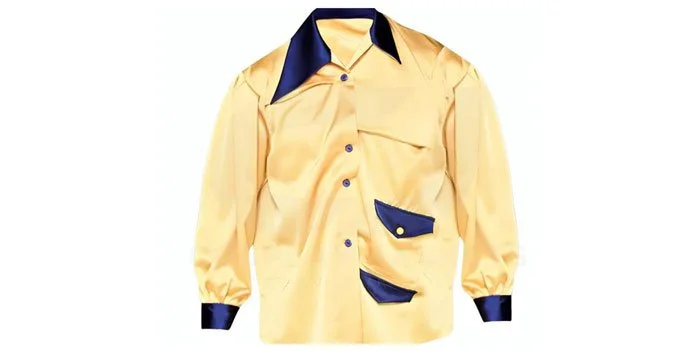
Why is good customer service so hard to come by these days? Asking for a friend.
Well, actually, a parent.
One day last week my dad called me, concerned about an online purchase he'd recently made. Apparently, after entering his payment info and clicking "Buy Now," the website swiftly charged his card and claimed he'd receive an order confirmation email — but it never came.
For two days my dad attempted to initiate a dialogue with this company. Since no phone number was listed on the website, his only recourse was email, but his inquiries all went unanswered. So, after 48 hours of radio silence, my dad turned to his personal "7 On Your Side" consumer advocacy / resident family computer geek — yours truly — for help.
At first, I had no clue what pops expected me to do. I think he thinks I have some kind of EZ-Pass to the information superhighway that helps me find anything — even humans at a company who apparently don't want to be found.
So I started asking questions — about the website, the transaction, his course of action — and I could hear his frustration level rising with each answer. As a kid I learned early that my dad has a low threshold for irritation. He can go from calm to crazy faster than Lewis Hamilton goes 0 to 60. But I needed more intel, so I kept probing ever-so gently.
When I asked if he'd ever shopped on the site before, he said he'd never even heard of it, but...
he saw this shirt...
and he had to have it...
because it would "complete an outfit."
If you can't tell, my dad's one of those older Black gentlemen who won't even go to the corner store to buy milk unless his 'fit is tight! He's the kinda guy who would show up at a pre-school graduation for his neighbor's kid wearing a black and white, pinstriped, three-piece suit with matching shoes and a fresh Stetson hat.
We had to get that shirt!
Unfortunately, my EZ-Pass supported searches yielded no phone number, so our last course of action was to contact his bank to file a fraud complaint. Before doing so, my dad had the brilliant idea to check his junk folder for the confirmation email — and there it was.
Two days old.
I could hear the relief wash over him.
Not because the company responded — but because he was finally gonna get that shirt.
I just hope it doesn't look like the one Denise made for Theo.
When Judgement Gets Designed Out
As painful as this experience was — for my dad, not the company — the system worked exactly as designed.
The order was accepted instantly.
The money moved cleanly.
The confirmation existed — just not where a human would reasonably look for reassurance.
The system wasn’t built to evaluate concern.
It was built to process transactions.
Responding to uncertainty requires judgment by a human — and judgment is messy.
It’s subjective.
It’s hard to standardize.
So instead of supporting judgment, the system quietly avoided it.
And when systems avoid judgment, they don’t just shape outcomes — they shape behavior. And by default, they reshape the people inside them.
But systems should support human judgment, not replace it.
Humans bring context, values, nuance, responsibility — the ability to decide what matters this time.
Systems provide structure, consistency, memory, efficiency — support for what repeats.
When that flips, problems arise.
Judgment starts to feel risky, so it becomes the thing organizations design around.
We can see this clearly in policy.
Rules are created to handle edge cases — then quietly become defaults.
No exceptions.
No conversation.
Not because the rule is wise, but because enforcing it is defensible.
“I don’t agree with it, but the policy says…”
That's not stubbornness. It’s judgment being pushed downstream.
We see the same pattern in AI.
Applicant tracking systems don’t reject people — they filter them. Algorithms don’t decide who’s qualified — they score likelihood.
No one ever tells you no. The system just stops responding.
The system isn't broken.
It's just optimized for efficiency and scale.
Not reassurance.
When systems stop acknowledging people, people stop expecting acknowledgment.
The most efficient systems aren’t the ones that work best.
They’re the ones people quietly learn to live around.
And that’s how systems learn they don’t need to change.
Question of the Week
Where in your work have you learned to adapt quietly instead of expecting acknowledgment?
Are you subscribed?
If you enjoyed this article and want more weird stories that make corporate life make sense, Sunday Setup lands in your inbox every Sunday at 3:30 PM ET.
Click the button below to get a weekly dose of humor and mindfulness to help beat the Sunday Scaries.
